
Technology Preview for secure value recovery
jlund on 19 Dec 2019
At Signal, we want to make privacy simple. From the beginning, we’ve designed Signal so that your information is in your hands rather than ours. Technologies like Signal Protocol secure your messages so that they are never visible by anyone but you and the intended recipients. Technologies like private contact discovery, private groups, and sealed sender mean that we don’t have a plaintext record of your contacts, social graph, profile name, location, group memberships, groups titles, group avatars, group attributes, or who is messaging whom. Plaintext databases have never been our style. We don’t want to build a system where you trust us with your data; we want to build a system where you don’t have to.
We’ve been working on new techniques based on secure enclaves and key splitting that are designed to enhance and expand general capabilities for private cloud storage. Our aim is to unlock new possibilities and new functionality within Signal which require cross-platform long-term durable state, while verifiably keeping this state inaccessible to everyone but the user who created it.
Make privacy stick
jlund on 17 Dec 2019
They get slapped on street signs. We wear them on our clothes to identify ourselves to distant coworkers during awkward holiday parties. Some people create massive galleries on their laptops in overlapping levels stacked so deep that the hinges begin to lose their structural integrity and LCD screens struggle to remain upright. The digital versions are even more popular, and we get asked about them a lot.
Stickers are everywhere, and now they’re in Signal too. They’re a fun way to add a new layer of expression to your conversations – and just like every other Signal feature, they are also encrypted, private, and secure.

Technology Preview: Signal Private Group System
jimio on 09 Dec 2019
Groups are inherently social, and Signal is a social app. Whether you’re planning a surprise party, discussing last night’s book club meeting, exchanging photos with your family, or organizing something important, group messaging has always been a key feature of Signal.
Signal provides private groups: the Signal service has no record of your group memberships, group titles, group avatars, or group attributes. We’ve been working on new private group technology that will enable group administrators and access control, improve group scalability, and set the stage for a much richer group experience – all while maintaining Signal’s unique group security and privacy properties. We’re moving into the future while keeping what we loved about the past.
Signal for iPad, and other iOS improvements
jlund on 27 Nov 2019
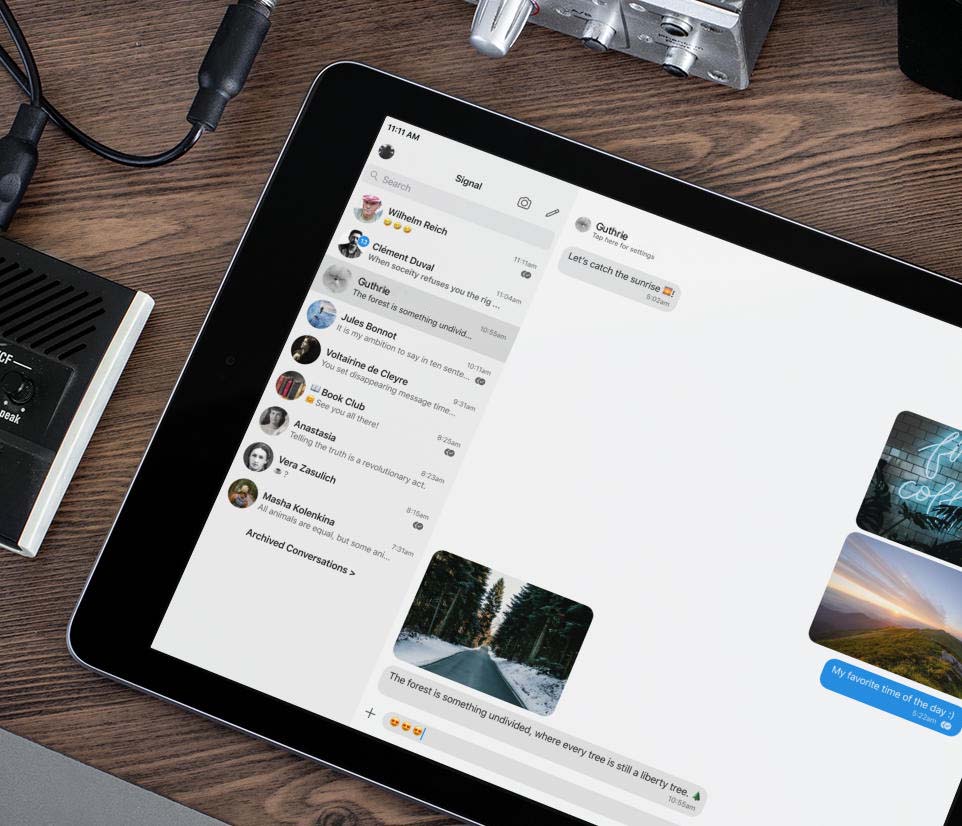
Signal 3.0 is now available in the App Store:
- iPad support has arrived. Set up your favorite tablet as a linked device.
- Forward messages between threads. Editing support lets you amend, extend, append, explain what you intend, or tie up loose ends before you hit send.
- Built-in support for video trimming can help any clip turn into a highlight.
- Tap on someone’s avatar in a group conversation to quickly message or call them. While the group agonizes over dinner plans, subtly exert your influence by making a case for your favorite restaurant in one-on-one conversations.
- Jump between threads and survey your message landscape (in landscape) with a horizontal inbox/conversation view on larger devices.
We would like to thank all of the alpha and beta users who helped us test and stabilize this release. If you want to get an early preview of new Signal features, you can join the beta community here.
I link therefore I am
jlund on 06 Feb 2019
The latest releases of Signal for Android, Desktop, and iOS are rolling out now with the ability to send optional link previews. This feature is built on the same foundation that has powered Signal’s animated GIF search for more than two years and that we have since expanded with additional privacy enhancements.

We’re launching link previews with initial support for Imgur, Instagram, Reddit, and YouTube. These are four of the most popular sites on the Internet and their heavy focus on visual content makes them a perfect fit for this feature. We don’t believe that privacy is about austerity, and now Signal users can see what’s behind the URL while sharing this content with their friends.
Setback in the outback
jlund on 13 Dec 2018
Like many others, we have been following the latest developments in Australia related to the “Assistance and Access” bill with a growing sense of frustration. The widespread adoption of strong cryptography and end-to-end encryption has given people around the world the ability to protect their personal information and communicate securely. Life is increasingly lived online, and the everyday actions of billions of people depend on this foundation remaining strong.
Attempting to roll back the clock on security improvements which have massively benefited Australia and the entire global community is a disappointing development.
Technology preview: Sealed sender for Signal
jlund on 29 Oct 2018
In addition to the end-to-end encryption that protects every Signal message, the Signal service is designed to minimize the data that is retained about Signal users. By design, it does not store a record of your contacts, social graph, conversation list, location, user avatar, user profile name, group memberships, group titles, or group avatars.
We have been exploring techniques to further reduce the amount of information that is accessible to the service, and the latest beta release includes changes designed to move Signal incrementally closer to the goal of hiding another piece of metadata: who is messaging whom.

A letter from Amazon
moxie0 on 01 May 2018
Last week, we received the following email from Amazon:
From: [redacted], [redacted] <[redacted]@amazon.com>
Subject: Notification of potential account suspension regarding AWS Service Terms
Moxie,
Yesterday AWS became aware of your GitHub and Hacker News/ycombinator posts describing how Signal plans to make its traffic look like traffic from another site, (popularly known as “domain fronting”) by using a domain owned by Amazon -- Souq.com. You do not have permission from Amazon to use Souq.com for any purpose. Any use of Souq.com or any other domain to masquerade as another entity without express permission of the domain owner is in clear violation of the AWS Service Terms (Amazon CloudFront, Sec. 2.1: “You must own or have all necessary rights to use any domain name or SSL certificate that you use in conjunction with Amazon CloudFront”). It is also a violation of our Acceptable Use Policy by falsifying the origin of traffic and the unauthorized use of a domain.
We are happy for you to use AWS Services, but you must comply with our Service Terms. We will immediately suspend your use of CloudFront if you use third party domains without their permission to masquerade as that third party.
Thank you,
[redacted]
General Manager, Amazon CloudFront
Signal Foundation
moxie0 on 21 Feb 2018
Long before we knew that it would be called Signal, we knew what we wanted it to be. Instead of teaching the rest of the world cryptography, we wanted to see if we could develop cryptography that worked for the rest of the world. At the time, the industry consensus was largely that encryption and cryptography would remain unusable, but we started Signal with the idea that private communication could be simple.
Since then, we’ve made some progress. We’ve built a service used by millions, and software used by billions. The stories that make it back to us and keep us going are the stories of people discovering each other in moments where they found they could speak freely over Signal, of people falling in love over Signal, of people organizing ambitious plans over Signal. When we ask friends who at their workplace is on Signal and they respond “every C-level executive, and the kitchen staff.” When we receive a subpoena for user data and have nothing to send back but a blank sheet of paper. When we catch that glimpse of “Signal blue” on a metro commuter’s phone and smile.
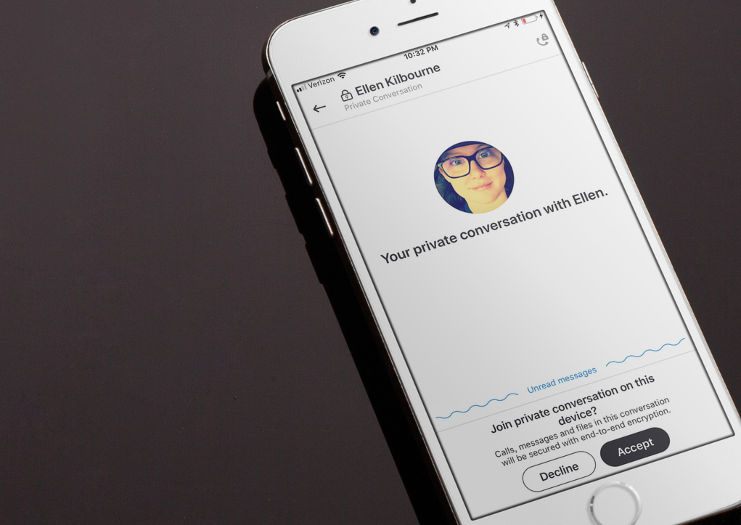
In collaboration with Signal, Microsoft is introducing a Private Conversations feature in Skype, powered by Signal Protocol.